Tuesday, October 19, 2010

Unguided Missiles

As James Traub points out in his most recent Foreign Policy column, Turkey currently aspires to be many things, some of which may ultimately contradict each other. Can one have rapidly warming political and trade ties with Iran while at the same time playing host to a new NATO-sponsored missile defense system that is squarely aimed at countering an Iranian threat? That appears to be the fix Ankara is currently in.

With NATO and Washington pushing for a new missile defense system, one that would make extensive use of Turkey's strategic geographic location, Ankara is now looking for ways to neither offend its neighbor to the east nor its allies in the West. In a column in Today's Zaman, analyst Lale Kemal takes a look at what appears to be Turkey's solution to the conundrum it is facing, which is to only agree to join the missile defense program if it doesn't name any specific targets. Is Tehran assuaged that easily? Perhaps.

Not joining the missile shield program is, of course, also an option for Turkey, but it would certainly only give only more ammunition to those making the case that the country is "drifting east," with more articles like this one certain to come. All in all, the missile defense decision appears to be one that crystalizes the difficult balancing act Turkey is trying to maintain while both hanging on to its traditional role as a reliable NATO member and developing its new role as a more independent and unconventional regional player.

More background on the missile defense debate in Turkey can be found in previous posts, here.


Friday, October 15, 2010

On "Public Opinion"

In the previous post, I wrote about the tricky nature of "public opinion" in Turkey. In a new piece for the German Marshall Fund, Bilgi University's Ilter Turan tackles the same issue, looking at a the results of a few recent public opinion polls taken in Turkey and trying to figure out what they say. His interesting analysis can be found here(pdf).

Friday, October 8, 2010

"Zero Problems, Maximum Trade": Chinese Edition


In July of 2009, after dozens of Uighurs were killed or went missing in the wake of ethnic riots in western China's Xinjiang province, Turkish merchants were setting fire to Chinese-made products, Prime Minister Recep Tayyip Erdogan claimed a "genocide" had been committed and a diplomatic crisis between Ankara and Beijing appeared to be brewing. (For more details, take a look at these previous posts.)

Cut to today, with Chinese Premier Wen Jiabao coming to Turkey on an official visit and announcing with Erdogan that the two countries are establishing a "strategic partnership" and plan to triple their trade in the next five years. This comes on the heels of reports that Turkish and Chinese military jets trained together, as part of the annual Anatolian Eagle exercises that Ankara last year controversially banned Israel from participating in (on the grounds that the Turkish public wouldn't accept the presence of the same military that attacked Gaza on Turkish soil). Uighurs? "Genocide?" Let bygones be bygones. Clearly Turkey and China have bigger fish to fry these days.

It's fairly obvious to say that when it wants to be, the Erdogan government can be exceedingly pragmatic, especially when the issue is expanding trade. But I think the interaction with China also says a lot about "public opinion" in Turkey and how it can be shaped by official attitudes. Since the "genocide" remark in July of 2009, Erdogan and other officials have said very little about the situation in Xinjiang and have refrained from criticizing China. The result? Where one would expect at least some reaction on the behalf of the Turkish public on behalf of their Uighur kin during the Chinese leader's visit, there has been silence.

Tuesday, October 5, 2010

Sowing the Seeds of Paranoia


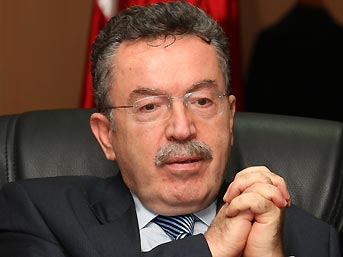
The start of the academic year is always a good time to instill some wisdom and knowledge in the minds of young and impressionable students, which is just what Yusuf Ziya Ozcan, head of Turkey's Higher Board of Education (YOK), tried to do in a recent talk in front of students at Central Turkey's Nevsehir University.

The subject of the talk given by Ozcan (pictured above) -- Turkey's highest-level academic, essentially -- was the importance of Turkey's universities ramping up their own research capabilities. To support his argument, Ozcan brought up the subject of tomato seeds, most of which he claimed are being imported from the United States and Israel, with dire consequences for Turkish eaters.

Here's a translation of what he had to say on the subject:
The seeds of the tomatoes and wheat we grow in Turkey mostly come from abroad, because we don't have enough seeds of our own. They come from the US and Israel. As a Turkish intellectual, sometimes I feel very little.

I mean, can't we produce our tomato seeds here in our country?.... And we don't know the consequences either. You're buying these tomato seeds. There is something called 'genetic programming.' They can implant a genetic mechanism into the tomatoes and we can eat it without even knowing. We can be infected with some diseases that we don't know anything about. In the meantime, you can destroy a whole nation. They can implant such things that people who eat these seeds die in the meantime. There are things like that and it is very dangerous. Therefore our universities need to help us in that matter.
More details (in Turkish) here.

Beyond the disturbing thought of the head of Turkey's highest academic body selling a group of students a conspiracy theory built on bad science, it turns out that Ozcan's basic data is also wrong. Forced to respond to Ozcan's allegations, Turkey's Minister of Agriculture said that the country, in fact, imports only about 6 percent of its seeds from Israel. More here.

More than tomato seeds imported from Israel, perhaps the greatest challenge facing Turkey is the quality of its educational system, from the primary level all the way to the top (for a very interesting take on that issue, read this great blog post by Aengus Collins). Ozcan's Nevsehir talk may be an indication of how far Turkey has to go in dealing with that challenge.


Monday, September 27, 2010

"Zero Problems, Maximum Trade"

There has been a lot of discussion regarding the political motivations behind Turkey's ambitious foreign policy moves, but what about the economic angle? The evolution of the mantra governing Ankara's new foreign policy from "Zero Problems With Neighbors" to "Zero Problems, Maximum Trade" seems to say quite a bit about what role economics and the pursuit of economic growth have to do with Turkey's changing approach to many of its neighbors.

I took a look at the economic underpinnings of Turkey's foreign policy in a recent article for Institutional Investor magazine. A pdf version of the article can be read here.

Today's Zaman, meanwhile, report today about another Turkish initiative that brings together Ankara's economic and political ambitions meet: the creation of a free-trade zone with Syria, Lebanon and Jordan. The article can be found here.


Monday, September 20, 2010

Mass Politics


I have an article and photo essay up on the Eurasianet website about yesterday's historic mass at the Akdamar island Armenian church in eastern Turkey's Lake Van. It was the first time a mass had been held in the church in 95 years and the event saw the largest number of Armenians in the Van area since 1915, when they were either driven or wiped out by the Ottoman authorities.

Although the event was seen by some as an elaborate public relations effort on behalf of the Turkish government and there was some controversy over the Turkish authorities failure to place a cross on the church's roof (its name in Armenian is, after all, "Church of the Holy Cross"), I still think the event was a significant one, in terms of getting Turks to come to terms with the fact that their country actually has an Armenian history and that Armenians can stake a claim (in historical and cultural terms) to parts of Turkey.

From my article:
As an Armenian growing up in Basra, Iraq, Vanuhi Ohannesian was always hearing about eastern Turkey’s Lake Van region, her grandparents’ birthplace and the place after which she is named.

Ohannesian’s grandparents were forced to leave the lakeside city of Van in 1915, when the Ottoman authorities drove out the region’s ethnic Armenians; her father was born during the family’s trek from Van to safety in Iraq.

“My father died two years ago and was always telling me to come to Van. He said this was our motherland,” said 68-year-old Ohannesian, who today lives in Los Angeles.

Some 95 years after her grandparents’ flight from Turkey, Ohannesian finds herself standing beside one of the Armenians’ most sacred sites, the 1,089-year-old church on Lake Van’s Akdamar Island. Closed since 1915, the island church was restored by the Turkish authorities between 2005 and 2007 and reopened as a museum.

On September 19, the authorities allowed a historic mass to be held on Akdamar, an event that drew several thousand visitors to the island throughout the day, including many Armenians from abroad, such as Ohannesian, who had never been to Turkey before.

“I never believed I would be coming here,” said Ohannesian, standing on a small hill that overlooks the church and holding a small bottle filled with lake water which she plans to bring back to Los Angeles and place at her father’s grave. “We believed people didn’t change, that if they did something once, they would do it again....”

....Cengiz Aktar, director of the European Studies Department at Istanbul’s Bahcesehir University, says the event may have been symbolic, but it also represents a deeper, more encouraging dynamic.

“It’s part of a slow but steady process of normalization regarding the non-Muslim minorities in Turkey and the glorious past of coexistence of religions in this land that was shattered by the emergence of the nation state,” said Aktar, who is active in civil society Turkish-Armenian reconciliation efforts.

“At the end of the day, there is a reality that is unearthed,” he continued. “This is what should prevail. At the end of the day, we are rediscovering the Armenian past in this region.”
You can find the full article here, and the accompanying photoessay here.

(photo: view of the Akdamar church in Lake Van, Turkey, taken in 2006. Photo by Yigal Schleifer)

Monday, September 13, 2010

Referendum Talk

I was on Chicago Public Radio's "Worldview" program talking about the Sept. 12 referendum in Turkey and the constitutional reform package that Turkish voters passed today. You can hear the interview, which also covers a number of other related issues, here.